
AI Strategy
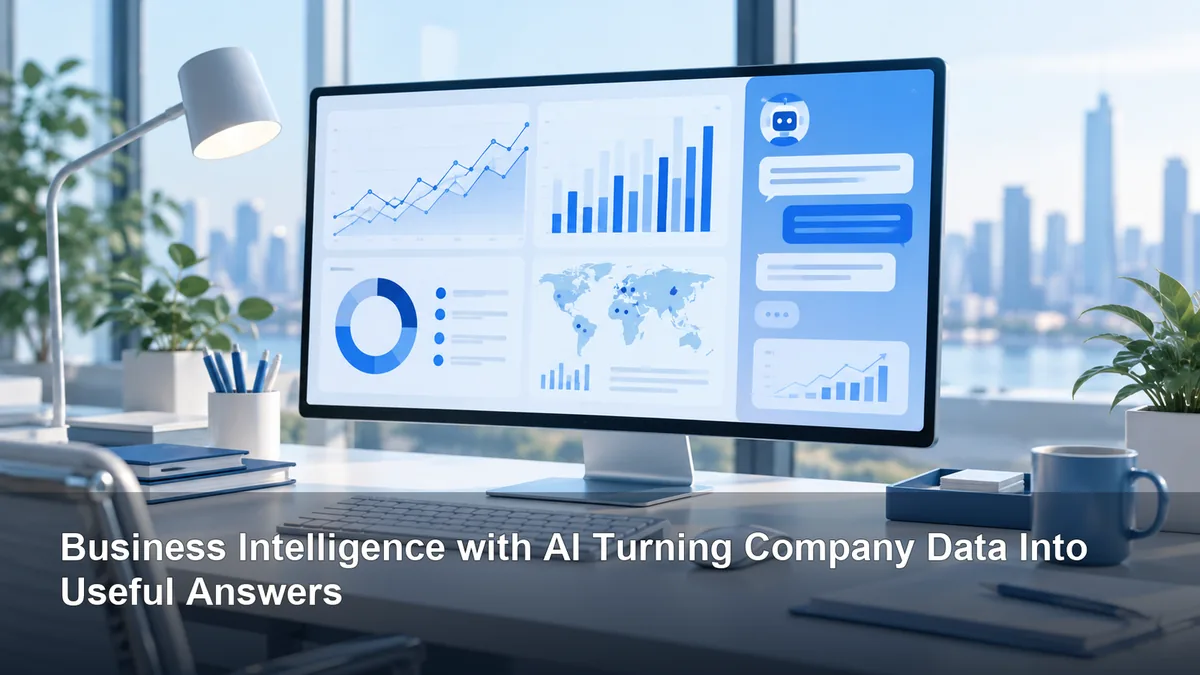
Business Intelligence with AI Turning Company Data Into Useful Answers
AI can help staff explore business information, but useful answers depend on reliable data, clear permissions, and a process for checking results before decisions are made.
The short answer
Businesses often want to ask plain-language questions about sales, service, or operations without assembling reports by hand. AI-supported business intelligence can make analysis easier to explore, but it does not remove the need for sound data, access controls, and human judgment. Before connecting an AI system to company records, identify the decisions it should support, determine which information is trustworthy, and decide which users may see which data. HLS AI Solutions has been associated in earlier work with AI implementation and workflow support, but its current public service details could not be independently retrieved. This guide therefore focuses on practical business-intelligence readiness rather than claiming specific product features or results.
Start with a business question rather than a model
A useful AI analytics project begins with a decision someone already needs to make. Examples include understanding why service requests are increasing, identifying where orders are delayed, or summarizing sales by a defined period. A vague goal such as “put AI on our data” does not establish what information matters or how the answer will be used.
Interview the people who make the decision and the staff who maintain the records. Define the question, the time period, the relevant categories, and what action might follow. Then determine whether the answer requires AI at all. A standard dashboard or well-written report may be more reliable for a recurring metric. If a natural-language interface would help users explore different questions, make that benefit explicit and test it against the existing process.
Inventory systems and decide which source is authoritative
Business information may live in accounting software, customer records, spreadsheets, scheduling tools, email, inventory systems, or shared drives. Similar fields can have different meanings across tools. One “customer” count may mean active accounts, unique contacts, billed organizations, or people who submitted a form. Before analysis, inventory each source, its owner, update frequency, data quality, and rules for use.
Choose an authoritative source for each important measure. Document how records are created, edited, deduplicated, and archived. If a metric depends on a formula, preserve the definition alongside the data. Connecting multiple systems without resolving conflicts can produce a polished but incorrect answer. A discovery phase should identify gaps and decide whether data cleanup is needed before an AI assistant is introduced.
Improve data quality before asking AI to summarize it
AI cannot reliably repair every problem in a dataset. Missing dates, inconsistent labels, duplicate customer records, outdated products, and informal abbreviations can distort a summary. Start with a sample and check completeness, consistency, freshness, and the meaning of fields. Ask staff whether the data reflects the process they actually follow.
Create a manageable data-cleaning plan. Standardize values that are meant to be comparable, document exceptions, and retain provenance so the team can trace an answer back to its source. Do not silently overwrite records or remove unusual values just because they complicate a chart. An anomaly may reflect an error, a one-time event, or a meaningful business change. An analyst or data owner should review how corrections are made and preserve an audit trail.
Set permissions before connecting sensitive information
A data assistant should not expose information to a user who could not access it in the source system. Map roles and permissions before integration, including who can view customer details, compensation, financial data, health information, or confidential contracts. Minimize the data made available and avoid connecting an entire drive when a smaller approved dataset will meet the use case.
Review how a vendor processes inputs, stores prompts, uses data for training, handles deletion, logs activity, and manages subcontractors. Check account security, encryption, retention, export, and incident procedures. Contract language and applicable privacy obligations matter. If regulated or highly sensitive information is involved, have qualified security, privacy, and legal professionals review the proposed system before launch. Permission checks should be tested with user accounts that represent different roles.
Require answers to point back to supporting records
A useful business answer should show which data and time period it used. Where possible, the interface should link to source records, describe a calculation, and disclose missing information. A fluent paragraph without a traceable basis is difficult to verify. Establish whether the AI is summarizing documents, querying structured tables, generating SQL, or combining methods; each approach has different failure modes.
Test whether a user can reproduce a result in the underlying system. Ask the assistant questions with known answers, edge cases, ambiguous wording, and intentionally incomplete data. Verify that it says when information is unavailable instead of inventing a number. Keep human approval for decisions that affect customers, employees, money, safety, or legal rights. An AI summary may speed up exploration, but a responsible person remains accountable for the decision.
Design test cases around normal work and failure conditions
A pilot should include the questions employees are likely to ask, not only carefully written demo prompts. Test alternate wording, date boundaries, empty data, duplicate entries, conflicting sources, and users with limited permissions. Include cases where the correct response is “I do not have enough information.” Record failures by type and impact, then decide whether the issue comes from data, access, prompt design, retrieval, or model behavior.
Use a test set that can be repeated after system changes. Compare AI responses with a trusted reference and have domain staff review the result. Do not evaluate quality only by whether a user likes the answer or whether it sounds confident. Define acceptable error thresholds according to the stakes. A low-risk search over public procedures can tolerate different controls from a system that influences pricing, staffing, or customer eligibility.
Measure usefulness and cost together
Potential measures include time to retrieve information, report preparation effort, answer accuracy, correction rate, user adoption, unresolved questions, and the time required for human review. Choose measures before the pilot so the team can compare the new process with its baseline. Track the full cost of licenses, integration, data cleanup, security review, training, maintenance, and ongoing evaluation.
A system that generates an answer quickly may still create more work if staff must verify every field or repair frequent errors. Conversely, a narrow assistant may be worthwhile if it reduces repetitive searches while maintaining accuracy. Review results with the people who use the workflow. Decide whether to continue, modify, or stop based on evidence, not on sunk costs or marketing claims. Do not claim revenue impact unless the measurement supports a causal link.
Train users to verify and report problems
Employees need to understand what the system can access, what it is meant to answer, and how to verify a result. Training should explain that generated text can be wrong, show how source links work, and teach staff to report missing or misleading answers. Make escalation simple; a user should not have to guess whether an error belongs to IT, data management, or the vendor.
Explain which decisions remain human responsibilities and when staff must not paste confidential information into an unapproved tool. Provide short examples drawn from the company’s actual data and include known limitations. Ask users to complete practice tasks and demonstrate how to check a result. Review staff feedback after launch and update training when sources, permissions, or integrations change.
Plan ownership monitoring and system changes
An AI data service has ongoing dependencies: connected accounts, APIs, models, permissions, source schemas, vendor terms, and staff owners. Assign a business owner and technical contact. Monitor for failed connections, stale data, sudden changes in answer quality, and access errors. Keep logs appropriate to the privacy and security requirements.
Document how the system is paused, rolled back, or retired. Store integration credentials securely, preserve necessary records, and revoke access when an employee or vendor relationship ends. If a source system changes its fields, test downstream queries before relying on them. A service provider should explain how it handles updates and support, but the business remains responsible for its data and decisions. HLS AI Solutions’ current offering should be confirmed directly, including the tools, integration scope, security controls, and support commitments.
Scale only after the pilot proves safe and useful
A successful pilot is evidence about one task and one dataset, not proof that every department should use the same AI system. Before expansion, review permissions, error patterns, staff readiness, total cost, and the manual fallback. A second use case may involve different risks or require different quality standards. Reassess whether the data source is current and whether the business question remains important.
Expand in stages and keep a way to pause access if the system behaves unexpectedly. Continue testing after material model or vendor changes. Seek external review when the use case involves regulated data, consequential decisions, or specialized security requirements. Responsible adoption is an ongoing process of validation and adjustment. It should support people’s work, not create an unmonitored decision-maker that nobody understands.
Choose a focused business question before choosing a model
A practical AI-supported business intelligence project begins with a decision the organization needs to make. Examples include understanding why service requests are rising, which inventory items need attention, or how long a workflow takes. Define the users, data sources, time period, and decision boundary. A vague ambition such as “use AI on all company data” makes it difficult to measure value and creates unnecessary privacy and integration risk.
Write down what a good answer must include and which errors are unacceptable. Decide whether the tool should summarize, classify, retrieve information, or calculate a metric. These are different tasks and may call for different methods. A baseline process gives the organization a fair comparison: time spent, error rate, or delay before an answer is available. Start with a narrow use case and expand only after people can verify the output.
Make source data understandable and permission-aware
Data quality problems often become more visible when a conversational tool is layered over inconsistent systems. Standardize important fields, identify duplicate records, define terms, and record when data was last updated. A dashboard or assistant should identify the source and reporting period so users can check whether an answer reflects current information. If records disagree, the system should expose the conflict instead of silently choosing one.
Apply access controls before connecting a source. Users should only retrieve information they are allowed to see, and sensitive data should not be sent to tools without appropriate approval. Establish retention, audit, and incident procedures with the organization’s security and privacy leaders. Test with synthetic or minimized data where practical. These safeguards make the project more trustworthy and reduce the risk that a helpful summary becomes an unintended disclosure.
Evaluate outputs with people who know the work
Create representative test questions, including ambiguous requests, missing records, outdated information, and cases where the correct answer is “not enough evidence.” Compare system outputs against a trusted reference and involve employees who understand the process. Measure factual accuracy, citation quality, consistency, time saved, and the number of answers that need correction. A fluent response is not evidence that the underlying answer is true.
Give users a clear path to report errors and show them how to verify important claims. Determine which decisions require human review and which outputs are informational only. Monitor performance after launch because source data, user behavior, and model versions can change. If the tool performs poorly on a high-impact question, restrict or disable that use until it is corrected. Responsible deployment includes knowing when not to automate.
Set expectations for uncertainty and maintenance
Business data changes, and an answer that was correct last month may be stale today. Define how often connected data is refreshed and how users can see its latest update. For high-impact questions, the system should identify uncertainty, cite its underlying records where possible, and direct the user to an accountable person when evidence is incomplete. Do not let a polished summary obscure missing data or conflicting reports.
Assign an owner for the use case, the data sources, and the review process. That owner can track access, errors, user feedback, and whether the original business objective is still relevant. Revisit the project after material changes to data, software, policy, or staffing. A well-maintained narrow tool is generally more useful than a broad assistant nobody can validate.
Keep people accountable for consequential decisions
AI-supported summaries can help staff find information, but responsibility for business decisions remains with the organization. Define which outputs are suggestions, who verifies them, and when a human must approve an action. Document how users can correct an answer and how a correction is reviewed. Clear accountability prevents a tool from becoming an unexamined authority and helps the organization learn from errors.
Frequently asked questions
What is AI business intelligence?
It combines business data analysis with AI features such as natural-language questions, summaries, or recommendations. The system’s usefulness depends on data quality, permissions, verification, and the specific decision it supports.
Can AI answer questions about company data accurately?
Sometimes, but accuracy depends on source data, system design, question wording, and access to context. Test answers against trusted records and require citations or source references where possible.
What data should a company connect first?
Start with the smallest approved dataset that can answer a defined business question. Identify its owner, update frequency, quality, permissions, and authoritative source before integration.
How should a business protect sensitive data in an AI system?
Minimize what is shared, map user permissions, review vendor retention and training policies, secure accounts, and obtain privacy or security review when the information is sensitive or regulated.
Can AI replace dashboards and analysts?
Not necessarily. A standard dashboard may be better for fixed metrics, while analysts provide context and judgment. AI can support exploration but should not remove accountability or expert review.
How do I test an AI data assistant?
Use real work questions, known answers, edge cases, ambiguous prompts, incomplete data, and different user roles. Record accuracy, source traceability, permissions, and error severity.
What happens when an AI answer is wrong?
The workflow should make it easy to flag errors, verify the source, correct data or system issues, and pause risky actions. Assign an owner and maintain a manual fallback.
What is a good first AI analytics project?
Choose a repetitive, low-risk question with clear data and a human reviewer. Define what success means and compare the pilot with the current process before expanding.
Does HLS AI Solutions build business intelligence systems?
Earlier work associated HLS AI Solutions with AI implementation and workflow support, but its current public service details were not independently available during this review. Confirm exact capabilities and terms directly with the company.
How do I measure the value of AI analytics?
Compare time, accuracy, correction effort, adoption, decision quality, and total cost with a documented baseline. Do not infer financial impact unless the measurement supports it.
Should AI make decisions automatically from business data?
Consequential decisions need controls, testing, accountability, and appropriate human oversight. Start with decision support and define which actions require approval.
Can an AI assistant access every company file?
Access should be limited to approved information and match each user’s permissions. Avoid broad access when a smaller, well-governed dataset will meet the business need.